
🎬 There's Something About Krypto
Our computer generated canary in the coal mine is dying

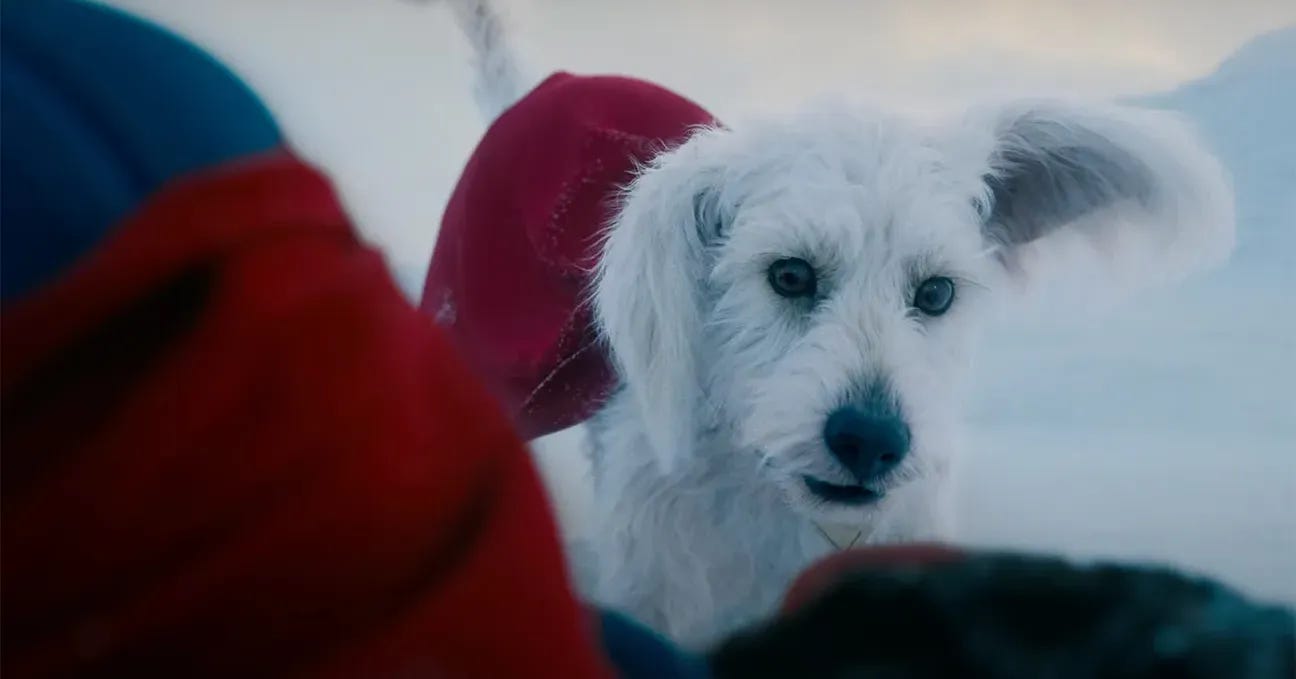
It’s a bird! It’s a pla… wait, is that a bird?
The animal actor unemployment line is starting to look like Noah’s Ark.
At the crossroads of affordable computer-generated imaging and advancing artificial intelligence, our four-legged friends are out of a job they never asked for. What began as need-based substitution is now heading toward total erasure, and it’s raising a few brows about what “real” even means anymore.
The Hollywood Reporter notes that jobs for animal actors are down to just 40 percent of what they were pre-pandemic according to industry trainers. So, is that a good thing? A bad thing? A harbinger of doom for SAG-AFTRA’s bipedal division?
My answer was most recently affected by a flying, four-legged fiend.
Like every other red-white-and-blue-blooded American, I watched Superman (2025). Given my personal flavor of superhero fatigue (an article for another day), I anticipated my core concerns to center on character development and adaptation. And, well, they did. Mostly. Except for one surprising addition: the dog.
Krypto the Superdog isn’t just comic relief. He’s an homage, a tonal counterweight, a marketing goldmine, and totally dead inside.
Whooshing into an IMAX close-up, his bones jiggle like Jell-O, his weightless fur shakes in spite of aerodynamics, and his eyes consume light and matter like two gaping black holes. “That’s not Krypto,” I thought. “That’s a puppet.”
Wait, actually—there’s something there. That’s not Krypto… it’s Crypto. With a C. Because it isn’t real. Like bitcoin. Or something… idk. (I’ll workshop it.)
Anyway, I wasn’t alone. Audiences and critics alike found CGI Krypto a little uncanny. He’s technically impressive but emotionally hollow. There’s just something dissatisfying about a recreation of the real McCoy.
James Gunn clearly understands this too. He famously delayed giving Cosmo a bigger role in Guardians of the Galaxy until the technology could do the character justice, though he later conceded to studio pressure and VFX improvements.
And none of this is to discredit the artists who made it happen. We’re talking about a photorealistic superdog interacting with complex environments, replicating the subtlest mannerisms of a real animal. It’s a triumph. These teams worked thousands of painstaking hours to bring Krypto to the big screen. But it’s still not enough. And that’s saying something.
The two most frequently cited arguments for supplementing real animals with fake ones are cost and safety. The idea is that training, handling, and accommodating real animals for major roles can add up to a higher price tag than a team of artists.
CGI animals can cost upwards of $50,000 per minute of screen time. Krypto appears in Superman for roughly eight minutes (I literally just rewatched mid-article to deliver you that number, you’re welcome). That’s speculatively $400,000 just for one digital dog. Meanwhile, a top-tier animal trainer might run you $1,200 a day.
Of course, real dogs can’t fly. Or at least, they choose not to when we’re looking. So yes, for midair hero shots, CGI makes sense. But in quieter scenes—like when Krypto lies on Kal-El’s chest as he wakes up at his childhood home—authenticity matters. We’ve all lived that moment, probably with a real dog and not a fake one.
Inauthenticity is poison to the mission of emotionally moving an audience. We’ll suspend disbelief for the mythic, but the familiar gets inspected under a microscope. You can’t cry over the death of something that never felt alive in the first place.
Missing Marcel
I recently started Friends (1994–2004) for the first time (I know, whatever). When Marcel the capuchin appeared, I was struck by how exciting it is to watch a cast actually interact with a living creature. It’s spontaneous. Unscripted. There’s something primal about it—an energy CGI can’t replicate.
Contemporary audiences are voicing the same realization. As The New Yorker recently noted in “Hollywood’s Turn Against Digital Effects,” both filmmakers and viewers are rediscovering the emotional weight of practical effects. We respond to what’s real.
Our emotional buy-in with CGI has always been shaky. Bonnie Judd, an animal coordinator based in British Columbia, recalled a moment with her canine co-star on A Dog’s Journey (2019):
“I tell the dog to close her eyes as the camera dollies in on her face, and the whole studio is bawling their eyes out … You don’t get that emotion with AI.”
If the value of a film is its emotional impact, we’re depleting the medium’s strength by snuffing out the life it’s meant to reflect.
For the Love of the Animals
“But it’s inhumane!” you scream at your screen as you read this.
As someone who’s personally worked with animals on set, I’ll stop you there. When productions follow American Humane guidelines, hire experienced trainers, and maintain healthy conditions for both humans and animals, movie sets are extraordinarily safe.
In fact, groups like Guide Dogs of America even train service dogs at studios to desensitize them to sound and light before working in unpredictable real-world environments. It’s like Nathan Fielder’s The Rehearsal, but for seeing-eye dogs. We had them at Warner Bros. last year, and they’re as talented as they are adorable.
The industry has devised long-standing, well-developed protocols that protect our animal thespians. And in moments when the performance becomes overtly dangerous or impossible, that’s precisely when digital assistance becomes appropriate.
Can’t Spell ‘Animal’ Without AI
CGI is one thing, but there’s the digital elephant in the room: AI.
While the technology is young, it’s already proven its ability to replicate real life with impressive accuracy—albeit with little creative nuance or control. It’s cheap, it’s scalable, and it’s seductive.
Yves Bergquist, director of the AI & Neuroscience in Media Project at USC’s Entertainment Technology Center, puts it bluntly:
“Studios do a lot of the postproduction work in films—particularly in animation—and there is a lot of pressure to bring costs down. The postproduction companies have a software development culture, so they will embrace generative AI.”
Soon, digital animals won’t just be possible, they’ll be economically inevitable. Which makes the ultimate question less “Could we?” and more “Should we?”
Because if we embrace replacing animals, humans are next on the chopping block with a similar set of arguments—economic, logistical, or otherwise.
Ultimately, the deciding factor is what an audience is willing to watch.
Movies and television are products that must please their audience to generate profit. Unlike toothbrushes or batteries, their value isn’t in how well they work, but in whether or not they move us.
So while it’s all well and good to make the product cheaper, safer, and more efficient, we can’t do so at the direct expense of efficacy. Filmmaking is unique in that the most economically viable product is not always the most advanced.
So I’ll ask you, the moviegoer, great and powerful consumer of media: what do you want to watch?